I've got an amalgam of thoughts jostling each other for space right now.
First, as I delve further into the writing Twitterverse, I keep coming across articles on common topics. One is what-you-should-be-Tweeting or how-to-be-a-successful-Twitter-writer or whatever. Here's my opinion:
Just be yourself.
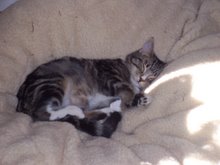
It's a lot like writing; it's important to speak with your authentic voice. There seems to be a lot of advice to advance your personal brand and be professional and useful and whatever else people want you to be. Apparently people don't want to know what I'm making for dinner or that I'm entertained by my cat snoring. Those people would be well advised not to follow me.
Granted, I do think you should learn from the things that annoy you in others, and not do them yourself. Learn from the things you admire in others, and adapt them to your own strengths.
I like to know both the professional and personal side of people I follow on Twitter; it's much like enjoying a well-developed character in a book. If you're only showing your professional side, you come across as pretty flat. Be a real person. There's only one of you. Tell me who you are.
Granted, I think a key to this is to try and have a sense of humor about it. Whether on Twitter or in real life, genuinely self-absorbed people are just boring. But random glimpses of others' quirks remind me of the notes struck by a really good poem, when I'm grateful to realize just how universal my individual perspective really is.
So, that's my little rant about "how to act on Twitter". In other news, while the rest of the writing world is launching into NaNoWriMo with all the frenzy that writing a novel in a month deserves, I'm throwing myself into NaNoEdMo rather like a dive into an icy pond. In other words, I'm editing the novel I wrote during last year's NaNo. I attempted the same project in May, and got through five chapters in two weeks. This morning, I got through those five chapters again, and yes, through chapter 6 as well. (Hooray! Progress!) Here's hoping that being unemployed will keep me swimming through the murky waters of revision.
Since I'm working on this project, a lot of the links posted by my tweeps are serving as helpful reminders on the craft of writing. I hope they help you too. The agent/publishing/marketing-related links will come later.
My sincere thanks for links and/or writing the actual articles: @inkyelbows, @megancrewe, @motjustes, @ElizabethSCraig, @Quotes4Writers, @AdviceToWriters, @benwhiting, @mystorywriter, @david_hewson, @WritersDigest, @brianklems, @jessicastrawser, @MFAConfidential, Jon Morrow and Stephanie Perkins.
Tips from a master of writing. From @MFAConfidential: Flannery O'Connor's take on the tenets of craft. http://ow.ly/15YolZ
From psych major and YA author @megancrewe: What makes a good story? http://j.mp/3gOhzY
From Elizabeth S. Craig's excellent blog: Different characters have different perceptions. http://short.to/v7hu
From crime writer Andrew Taylor: Getting the Plot Right. http://bit.ly/10vwGX
From Jon Morrow: No one but you is an authority on your writing. http://bit.ly/r3nK3
To become a better writer: Intense, focused practice. http://bit.ly/1NpapO
He's absolutely right about the Facebook/Twitter trap. From @david_hewson: Keeping your writing alive - even when you're not writing. http://ow.ly/x71i
From @brianklems: 4 Tips for Choosing the Right Word. http://ow.ly/xmw7
I'm not quite sure how I ended up on the following blog, but I enjoy the irony of her digressions as she talks about how important it is to stay focused on your plot. Irony aside, good tips on self-editing:
http://naturalartificial.blogspot.com/2009/10/scarf-weather-answers-part-eleven.html
Showing posts with label character. Show all posts
Showing posts with label character. Show all posts
01 November 2009


04 June 2009
Another take on Vonnegut's Seventh Rule
I was thrilled to be asked to guest post on www.fictionmatters.com:
I'm intrigued by the concept of Vonnegut’s Seventh Rule, which essentially is to write for one person rather than the whole world. I’ve never really considered writing for the whole world; instead, I find myself writing for my main character. After all, if I don’t tell his story, no one else will. And if I can tell the story to his satisfaction, I’m certain to end up happy with it as well.
(Side note: I’m rather enjoying the fact that Vonnegut would’ve hated that semicolon in the preceding paragraph.)
I think one’s instinctive audience is deeply intertwined with one’s creative process. Every (good) story I’ve written has started because a protagonist popped into my mind, in a sort of reverse-Athena-birthing, whispering urgently that they must tell me about this thing. Or I’ll get a sudden image of this person - who’s never occurred to me before - in the middle of an intriguing action, and realize I must know what happened next. Or maybe I do know what happened next, and before too, and realize that for his sake and mine, I must tell his story, now now now.
There are some great advantages to this approach, in my opinion. My protagonists become close friends of mine, because I take their stories seriously, and they know I’m listening. Writing for them helps me with characterization quite a lot, because they’re driving the story so much that all I have to do is pay attention, and a thousand tiny details come forth with relatively little effort.
It also helps me with developing other characters. Since the secondary characters are all there because they’re a part of the protagonist’s life, I tend to see them from the protag’s point of view. How they respond to the main character, and how he responds to them, helps me understand both people better. The drawback, not surprisingly, is that this can make my secondary characters a bit flat at times. But hey, that’s why we have revision, right? I’m a big believer in getting the first draft down on paper and worrying about making it great on the next go-round or twenty.
Another thing I love about this approach is that the inspiration is all wrapped up with it. Whatever inner emotion makes this character so urgent, so insistent that I tell their story, tends to be one of the main themes. Even better, since that passion is innately contained within their personality, I typically don’t have to put a lot of conscious thought into the character’s motivation. It seems natural that the protagonist’s motivation and the story’s overall themes are linked in a necessary - indeed, inextricable - way. Granted, I may not fully understand that motivation or the themes until I’m knee-deep in the story, but I just keep trusting my main character and in time, all is revealed.
Focusing on telling this specific character’s story to his satisfaction helps me to hone in on the plot, too, even if I can’t see all the way to the end when I first start jotting down the scenes and images that occur to me. If I start to get lost, or bogged down, I can turn to the protagonist and say, “Sorry, what were we talking about? I got a little distracted.” In a very real sense, the protagonist is like a guide leading me along an unfamiliar trail through the forest. It doesn’t feel like I’m making up his story; I’m listening to it, asking questions, and writing as fast as I can.
I'm intrigued by the concept of Vonnegut’s Seventh Rule, which essentially is to write for one person rather than the whole world. I’ve never really considered writing for the whole world; instead, I find myself writing for my main character. After all, if I don’t tell his story, no one else will. And if I can tell the story to his satisfaction, I’m certain to end up happy with it as well.
(Side note: I’m rather enjoying the fact that Vonnegut would’ve hated that semicolon in the preceding paragraph.)
I think one’s instinctive audience is deeply intertwined with one’s creative process. Every (good) story I’ve written has started because a protagonist popped into my mind, in a sort of reverse-Athena-birthing, whispering urgently that they must tell me about this thing. Or I’ll get a sudden image of this person - who’s never occurred to me before - in the middle of an intriguing action, and realize I must know what happened next. Or maybe I do know what happened next, and before too, and realize that for his sake and mine, I must tell his story, now now now.
There are some great advantages to this approach, in my opinion. My protagonists become close friends of mine, because I take their stories seriously, and they know I’m listening. Writing for them helps me with characterization quite a lot, because they’re driving the story so much that all I have to do is pay attention, and a thousand tiny details come forth with relatively little effort.
It also helps me with developing other characters. Since the secondary characters are all there because they’re a part of the protagonist’s life, I tend to see them from the protag’s point of view. How they respond to the main character, and how he responds to them, helps me understand both people better. The drawback, not surprisingly, is that this can make my secondary characters a bit flat at times. But hey, that’s why we have revision, right? I’m a big believer in getting the first draft down on paper and worrying about making it great on the next go-round or twenty.
Another thing I love about this approach is that the inspiration is all wrapped up with it. Whatever inner emotion makes this character so urgent, so insistent that I tell their story, tends to be one of the main themes. Even better, since that passion is innately contained within their personality, I typically don’t have to put a lot of conscious thought into the character’s motivation. It seems natural that the protagonist’s motivation and the story’s overall themes are linked in a necessary - indeed, inextricable - way. Granted, I may not fully understand that motivation or the themes until I’m knee-deep in the story, but I just keep trusting my main character and in time, all is revealed.
Focusing on telling this specific character’s story to his satisfaction helps me to hone in on the plot, too, even if I can’t see all the way to the end when I first start jotting down the scenes and images that occur to me. If I start to get lost, or bogged down, I can turn to the protagonist and say, “Sorry, what were we talking about? I got a little distracted.” In a very real sense, the protagonist is like a guide leading me along an unfamiliar trail through the forest. It doesn’t feel like I’m making up his story; I’m listening to it, asking questions, and writing as fast as I can.
Subscribe to:
Posts (Atom)

 Posts
Posts

